
Where Is My Money?
A Plain English Guide to How Your Rent Becomes Your Deposit
Do you know where your rent money is right now?
Not in a vague sense. Literally, at this moment, is it sitting in a tenant's bank account, moving through the Federal Reserve, resting in a processor's holding account, or already in yours? Most owners have never asked the question because they've never had to. That is what a good property manager buys you. Peace of mind is not a feeling we manufacture. It is the result of a system working quietly in the background so you never have to think about it.
But every so often, curiosity gets the better of a client. You see a rent payment logged on the fifth and your deposit doesn't land until the ninth, and a small voice asks, "what exactly is happening in those four days?" That is a fair question, and it deserves a real answer, not a shrug.
The Short Version
Your rent money makes two separate trips before it becomes your distribution.
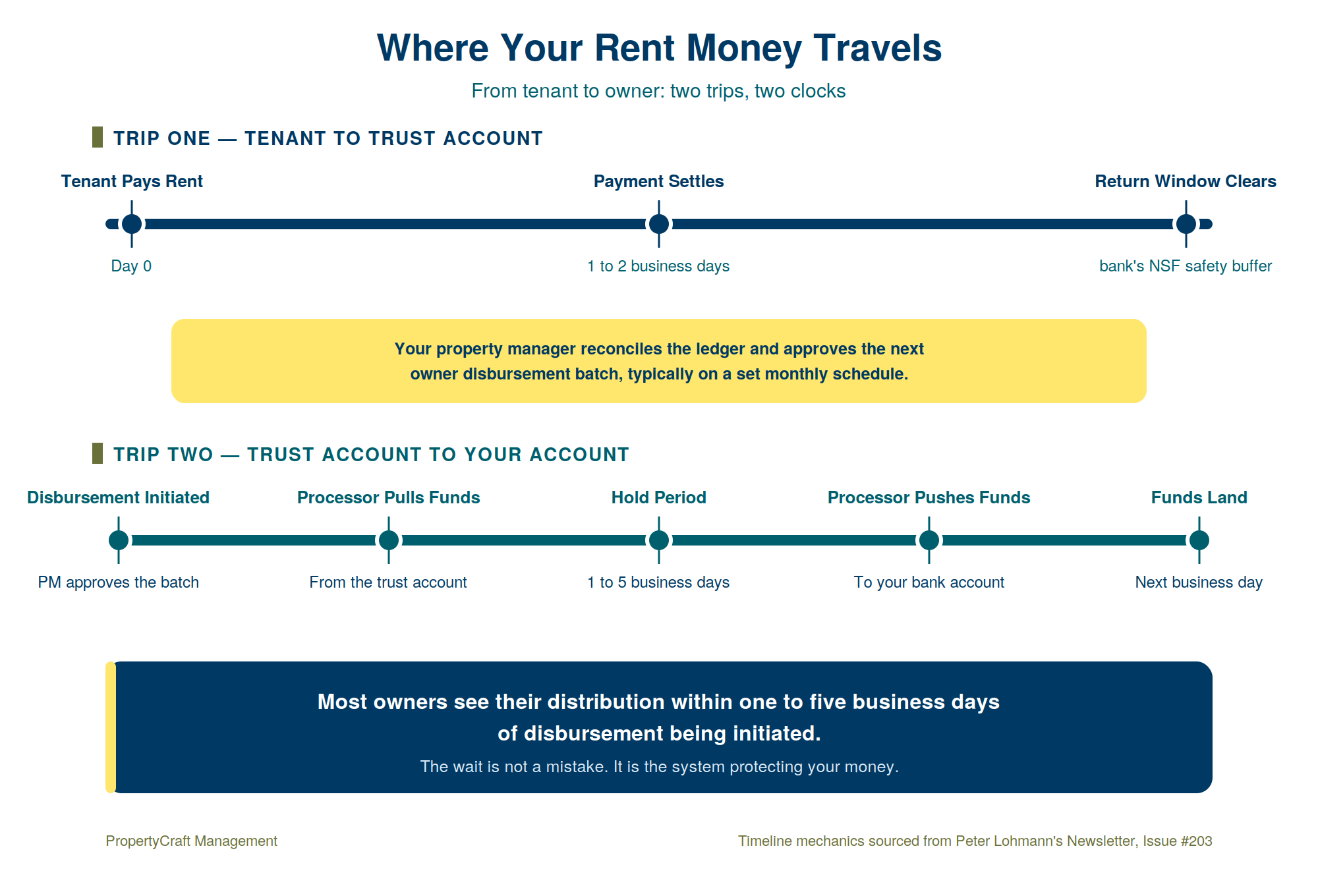
Trip one: Money leaves your tenant's bank account and lands in your property manager's trust account.
Trip two: Money leaves the trust account, passes briefly through a payment processor, and lands in your bank account.
Two trips, two different clocks, and a good reason for each.
Trip One: Tenant to Trust Account
When a tenant pays rent through ACH, the payment typically settles in one to two business days. Quick, but not instant. Underneath that quick settlement sits a quieter rule: the tenant's bank has a two business day window to reverse the payment if the funds weren't there to cover it. That window exists to protect the banking system from bounced payments, and it means a rent payment isn't truly, unquestionably final the moment it shows up as "settled." It needs a beat to prove itself.
This is also where your property manager's software earns its keep. Every rent payment, every late fee, every partial payment gets logged and reconciled against your lease terms automatically. That is not a nice-to-have. It is the difference between a property manager who can tell you, to the dollar, what each unit owes and one who is guessing off a spreadsheet updated whenever someone remembers.
Trip Two: Trust Account to Your Bank Account
Here is the part most owners never see, and it is worth understanding, because it explains the timing you actually experience. When your property manager pays you out, the money does not go directly from the trust account to you. It goes through a payment processor first, in two separate ACH transactions.
First, the processor pulls the money out of the trust account. Second, after a holding period, the processor pushes the money into your account. That push settles fast, usually the next business day, once it happens.
The holding period in the middle is the part that raises eyebrows, so here is the honest reason for it. A pull can bounce. A push cannot be undone. Once your deposit lands, it is final, no clawback, no do over. So before any processor will push money out to hundreds or thousands of owners, it wants confidence that the pull from the trust account actually stuck. That confidence takes a few business days to build. Depending on the platform, most owners see their distribution land somewhere between one and five business days after disbursement is initiated.
Is that hold generous to the processor? Sure. Is it also a reasonable way to prevent a cascade of failed payments across an entire platform? Also yes. Two things can be true.
Why the Platform Matters More Than the Wait
Here is where we will gently push back on a common assumption: that a property manager who could disburse funds to you a day or two faster is automatically the better choice. Speed is nice. It is not the point.
The real value of a professional property management platform is not shaving a day off your deposit. It is the infrastructure underneath it: automated rent tracking, delinquency alerts the moment a tenant falls behind, a clean audit trail if you ever need to prove what was collected and when, and a baseline accounting system that catches errors before they become your problem. A self-managed landlord running rent through a personal bank account has none of that. They have faith and a checkbook.
We think of it the way a good CPA thinks about your taxes. You are not paying for speed. You are paying so that when the number lands in your account, you never have to wonder if it is right.
The Bottom Line
Your rent takes two short, well-supervised trips before it becomes your monthly distribution. The first trip, tenant to trust account, typically wraps in one to two business days. The second trip, trust account to your bank, typically takes another few business days once your property manager initiates disbursements. None of this is a mystery, and none of it is a delay for delay's sake. It is a system built to make sure that when your money moves, it moves correctly the first time.
A sincere thank you to Peter Lohmann, whose newsletter deep dive into ACH mechanics for property managers (Issue #203, "ACH Deep Dive for Property Managers: Your Questions Finally Answered") did the heavy lifting of untangling Nacha rules, processor float, and settlement timing. His research made it possible to translate a genuinely confusing banking process into something owners can actually use.